Overview
Undergraduate final-year project, HKUST
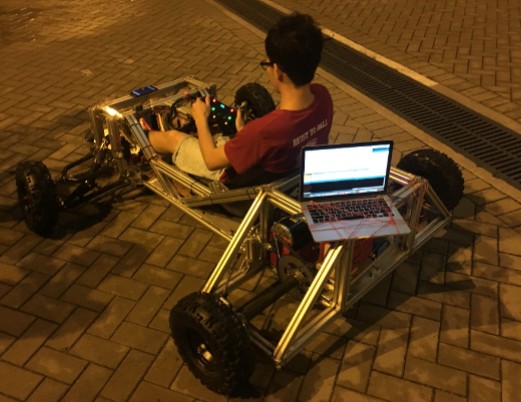
A team EV prototype designed to improve cornering through two independently driven rear wheels: a steering-angle sensor measured driver input and the system adjusted rear-wheel power accordingly. I was responsible for all mechanical design on the second prototype — chassis, steering geometry, suspension packaging, braking integration, and overall vehicle layout.
Report: View final report PDF →
What I Worked On
The first prototype had weak chassis stiffness, poor steering geometry, and weight distribution that made the control concept difficult to evaluate. My role was to redesign the mechanical platform so the active rear-wheel-drive idea could be tested credibly.
I improved chassis stiffness using simulation-driven design while reusing material from the earlier prototype, reworked the steering geometry toward an Ackermann-like setup, and packaged the suspension and braking system within the available space. Structural and geometric decisions were treated as part of the vehicle-dynamics problem: if the chassis flexed too much or the steering geometry was off, any effect from steering-angle-based rear-wheel torque control would be difficult to interpret. A significant part of the work was exercising engineering judgment under real constraints — incompatible purchased parts, limited budget, and deciding what was worth redesigning versus what was good enough.
Technologies
SolidWorks · FEA · Chassis design · Steering geometry · Suspension packaging · Vehicle integration · Prototype manufacturing · Active rear-wheel drive
Gallery